Tuesday, April 17, 2012

A Great Catholic Kids Book: Seven Lonely Places, Seven Warm Places

This isn't a regular feature here, but really should be: great Catholic books for kids.  I am especially interested in books that are great to read aloud.

Here's a must-have.  I'm recommending this not just as a one-time read, but a book to add to your library and read often.  It's Seven Lonely Places, Seven Warm Places: The Vices and Virtues for Children by April Bolton, illustrated by Brent Beck.  It was first published in 2003 by St. Anthony Messenger Press (now known as Franciscan Media).


My own children are generally great judges of what makes a good read-aloud, as we have done so much of it over the years, and they have always loved this book.  But I knew Seven Lonely Places, Seven Warm Places was a real winner when I read it to six different grades at our children's Catholic grade school.  Many of those kids fidget, or will tell me or show me flat out, when a book does not interest them.  All of the grades--from K through 5th grade--sat in rapt attention during the reading of this book.  And the comments! Oh the comments! The discussions we had about this book, the illustrations, the message.  Especially from kindergarteners.

I strongly urge you to have this book on hand, read it to your kids, and sit back and wait for some amazing discussions about virtues.  Here's a link to the publisher's website for the book, and I'm sure it's available at various Catholic retailers.

Sunday, April 15, 2012

April Catholic Post Column: Word on Fire


Following is my April Catholic Post column that appeared in this weekend's print Post.  I loved the idea of a Bible that makes lectio divina practically effortless, and I also point readers to a great book for an introduction and "why you should" consider lectio.  I invite your feedback here or on Facebook or Twitter.


Here’s the problem for a book reviewer:  how do you review the Bible?

Potential review: I laughed, I cried, I was moved.

Pros: I love the author.

Cons: it’s really, really long.

Cue The Catholic Prayer Bible: Lectio Divina Edition, published by Paulist Press and edited by Lawrence Boadt, CSP.  This well-designed Bible makes lectio divina—“divine reading”--doable for the average Catholic.

So I confess that this isn’t really a review of the Bible as text, but rather showing how this edition of the Bible is built on the ancient Christian practice of lectio divina, a prayerful way to read (lectio) the Divine Word of God.

I’ve seen lectio divina broken into various numbers of steps, from four to seven, but Fr. Boadt provides four:  Read, Reflect, Pray and Act.

Fr. Boadt recommends sticking with an entire book of Scripture and not just jumping around, but I’m grateful to see that he’s not recommending that one read the Bible start to finish.  I tried that way back in my 20s when a Protestant friend gave me a schedule for reading the Bible in one year.  I got somewhere into Numbers before I gave up, an utter failure.

I hope that increased maturity, and the accountability of having to write about it here and on the blog, will help me to be better about making Scripture reading & prayer part of my day. But it’s The Catholic Prayer Bible itself that makes it much more achievable.

The Catholic Prayer Bible is simply laid out.  The Scripture itself takes up two-thirds of the page, with a small box of lectio divina reflections for each of the four steps (Read, Reflect, Pray, Act) in a small dark red box on the remaining third.  There are short prompts for each of the steps.  For instance, in John 13:1-30, where Jesus washes his disciples’ feet, the “Act” step is: Perform some humble service for another, especially someone who is dear to you.”

I love how The Catholic Prayer Bible makes it painless and even easy to jump in, right now, to incorporate lectio divina into a busy life.

The Scripture readings are short, bite-sized portions, no more than several dozen verses.   It’s not an overwhelming amount of text to “get through” through before praying and reflecting.

The Catholic Prayer Bible helps slow fast readers down.   I’m a fast reader in general; that’s helpful as a book reviewer.  But when reading Scripture, I find it difficult to just slooow down and savor.  Having just a few verses to read, reflect, pray and act on makes that “slowing down” much easier.

The “Act” prompts, in particular, helps the reader come away with a specific resolution to bring into everyday-ness.  Even when I found the “Act” suggestion unhelpful or not relevant, it prompted me to make a resolution of my own to bring Scripture into my life.

If you want more of the “how-to” and why of lectio divina, as well as a beautiful, easy-to-read history and reflection, consider the recent Praying Scripture for a Change: An Introduction to Lectio Divina. The book is by Dr. Tim Gray, best known for partnering with Jeff Cavins in developing The Great Adventure Bible Study series. 

Gray says, “If you have trouble praying, then welcome to the human race.”  Praying Scripture for a Change offers reasons and practical tips of how lectio divina can work to help us get over our natural inclinations not to jump into prayer.  This book inspired me to consider deeply why it’s important to let God speak to me through Scripture. 

Reading Praying for a Change will give you the desire to incorporate lectio divina into your prayer life.  Using The Catholic Prayer Bible will make it easy for you to start.  Then, prepare to reap the real spiritual and temporal benefits of this ancient practice. 

Friday, April 13, 2012

Meet a Reader: Deacon George Geagea


I'm delighted to feature as a "reader" this month Deacon George Geagea.  Thank you so much, Deacon, for agreeing to be featured this month. 


How you know me:

I’m Deacon George Geagea, a deacon at St. Sharbel Maronite Catholic Church in Peoria.  I have been married for 30 years to my wife Najeebe, and we have 5 children—Jeanette, Nadia, Amanda, Gabriel and Rachel.  I work as the chief administration officer at Illinois Neurological Institute.  I was born and raised in Lebanon, and moved to central Illinois at the age of 18. 

Why I love reading:

Reading makes me use my imagination and helps me get into the mind of the author, helps me gain different perspectives of issues and expands my thinking.  Genres I enjoy reading include spiritual and inspirational books and self-improvement books.

What I’m currently reading:

I am currently reading a book by Fr. Larry Richards titled Be A Man! Becoming The Man God Created You To Be.  He has a simple, yet profound, message to Catholic men about how to experience the real presence of God in our daily lives.

My favorite books: 

I have two favorite recent reads.  The one that really captured my imagination and made me think at a deeper level was Jesus of Nazareth by Pope Benedict XVI.  This book differentiates between the historic Jesus and the person Jesus who lives forever.

Another recent favorite is Contemplating the Trinity: The Path to the Abundant Christian Life by Father Raniero Cantalamessa.  Fr. Cantalamessa is preacher to the papal household, and it is an excellent read.  In Contemplating the Trinity, Father Cantalamessa looks at the Trinity from multiple dimensions, such as the Trinity and beauty, or the Trinity and love, and goes deep into the mystery of the Trinity and its relationship to humanity.

Sunday, April 1, 2012

First, What Are You Reading? Volume 20, April 2012


Last year, I did an April Fool's version of First, What Are You Reading?, but this year I don't want to waste an opportunity to share some really good books with you.  Enjoy, and I can't wait to hear what you are reading.

Here are my answers to the four questions I ask on the first of each month:
first, what are you reading?
what do you like best about it?
what do you like least?
what's next on your list to read? 

As always, I hope you'll consider your current reads on your blog and/or sharing here in the comments or on Facebook.  Happy reading!

First, what are you reading?  

Nursery Rhyme Comics: 50 Timeless Rhymes from 50 Celebrated Cartoonists with an introduction by Leonard S. Marcus

Nerd Camp by Elissa Brent Weissman

What do you like best about them?

The graphic book I was going to talk about in this space was so bad I don’t even want to name it .  It was about media bias and media coverage, and it was terrible.  Far better for kids and adults to have a healthy sense of

So I decided to substitute another graphic novel read that is well-done, and Nursery Rhyme Comics fits the bill.  I really enjoyed the interesting takes on classic Mother Goose-type rhymes.  Some are better than others, but it’s a neat idea.  Leonard Marcus’ introduction talks about how each artist was able to craft a “back story” for the rhymes.  I especially loved “Pat-a-Cake” by Gene Luen Yang and “Hickory Dickory Dock” by Stephanie Yue.

Love, love, LOVE Nerd Camp.  Gabe is 10 years old, and heading off to the Summer Center for Gifted Enrichment, better known as Smart Camp for Geeks and Eggheads, or Nerd Camp.  He realizes he is a nerd because of his soon-to-be stepbrother Zach, who scoffs at things “nerds” would like, like reading actual books, being in math club, and going to camp to learn.  Gabe decides to make a logic proof of the whole summer, deciding whether or not he is, in fact, a nerd. 

I read Nerd Camp one weekend afternoon after a morning of cleaning and when I was too tired to do any “real” writing or tougher reading.  It was just the right pick-me-up.  I laughed out loud, delighted in the story and in how terrific it is to be a nerd. 

Great things about the actual camp, and why I want to go there:

*a Funny Quotes poster, where Gabe and his buddies write down funny things they say

*learning the digits of pi.

*the  karaoke sing-off between Gabe and his girl nemesis (or friend?) Amanda.  The song?  An alphabetical listing the countries of the world.    I’m “this” close to writing the author of the book to see if such a song really exists.

*Jeopardy with Alex Trebeck as the actual host.

*a 13-year-old who is the “cool” nerd for making a clandestine lab at camp.

What do you like least about them?

Because there are so many artists in Nursery Rhyme Comics, there are plenty that fall flat, or just really aren’t as good as others.  But so many do work, I think the book is a worthwhile read overall.

It’s just a little sad that part of Nerd Camp revolves around a divorce, with parents sharing custody of Gabe, and his father getting married again.  But it’s not handled negatively or positively.  It primarily serves as a plot device to put Gabe in the path of a non-nerd in the form of his soon-to-be new step-brother.  In our family, this just served as a discussion topic, brought up seamlessly.

What’s next on your list to read?

Working through a list of potential fiction for my June column.  This is no problem, as I love fiction.  Finding the time amid spring cleaning and “life” has been more of a challenge lately.

So, what are you reading these days?  Any books you would like to share?

Wednesday, March 28, 2012

Q &A with Mark Shea, author of The Work of Mercy: Being the Hands and Heart of Christ

Following is my interview with Mark Shea, author of The Work of Mercy: Being the Hands and Heart of Christ.  I reviewed Mark's book in my March Catholic Post column.  This Q&A is a shorter version of a far-ranging phone conversation we had about his book and his writing.  Thanks, Mark, for being so willing to talk with me, and for your great book!

Q.  Please tell Catholic Post readers a little more about yourself and your work.

I’m an author of a number of books, most recently The Work of Mercy.  I’ve also written a book called By What Authority? among others.  I write a lot for the Catholic press. I have a blog that I write for the Patheos and the National Catholic Register. I’m a convert to the faith, and was received into the Church in 1987.

How I started writing books is interesting.  I was confirmed in December 1987.  The following month a friend of mine told me he didn’t believe in the Real Presence.  I sat down and started a letter to the author Peter Kreeft (philosophy (we had corresponded when I had been coming into the Church) , trying to articulate why I did believe in the Real Presence.  The letter got bigger & bigger, and by the time I was done, 10 months later, it was the script of my book, This is My Body: An Evangelical Discovers the Real Presence.  I’ve always chalked up the explosion of my writing to the sacrament of Confirmation.

Q.  Why a book on the works of the mercy?

I hadn’t seen one in awhile, and it seemed to me that reacquainting the modern audience was a good idea since the works of mercy are essential to our salvation.  They go right back to Jesus’ famous parable of the sheep and the goats, in which what’s make or break for both the sheep and the goats is the works of mercy—how did you treats the least of these.  “I was hungry and you gave me something to eat, I was hungry and you didn’t give me something to eat.” That’s what that parable is all about.

Archbishop Chaput is speaking gospel truth when he warns us very bluntly
“If you neglect the poor, you will go to hell.”  That’s why a book on the works of mercy.

Still, our response to the works of mercy is left up to our prudence; there’s guidance from the church, but how you live out the works of mercy is left up to the person.

There are basically two classes of the works of mercy that the church has teased out of tradition.

First, the corporal works of mercy (feed the hungry, clothe the naked, ransom the captive, visit the sick, bury the dead).  Those are addressed to the fact that yes, we are spiritual beings, but we are also bodily creatures, so our bodily needs matter. 

The reason a body matters is because a). the body is the creation of God and b). God himself has taken on a body in the Incarnation of Jesus.  He’s become human.  Our humanity really matters.  It was through the body that our salvation was won.  It was through Jesus’ very physical, very graphic, very bloody crucifixion and his bodily resurrection that our salvation was won.  And so the body really matters in the Catholic tradition.

In addition to that, there are also the spiritual works of mercy, such as instructing the ignorant, admonishing the sinner, bearing wrongs patiently, forgiving wrongs, praying for the living and the dead. These works of mercy are addressed to the fact that we are not just bodily creatures-- we are more than cows.  Our concern is more than just getting our three square meals a day and keeping our belly full.  As Jesus says, man does not live by bread alone but by every word that proceeds from the mouth of God. 

Both of these classes of works of mercy are essential in the Catholic life. That’s what my book is attempting to do—bring out the fullness of what those works of mercy mean. 

They all have a spiritual application as well.   So when we speak of feeding the hungry, for example, we mean, yes, people are starving in Africa and we feed them.  But in addition, what the Catholic tradition has always seen in giving bread to the hungry is ultimately a reference to the Eucharist.  Jesus will say to the Jews in John 6, that Moses gave you manna in the wilderness, he fed your bellies, but your fathers all died after they ate that.   The bread that I will give you will eat of and you will live forever.  I am the Bread of Life, Jesus tells us.

Over and over again you’ll see in the works of mercy the spiritual overtones of the spiritual element.  In give drink to the thirsty, Jesus tells the Samaritan woman at the well, whoever drinks the water that I give will live forever.  And that water is the Holy Spirit.

And ransoming the captive, Jesus speaks of himself of giving his life as a ransom for many.  In addition to supporting anti-slavery organizations, for example, we also ransom people out of captivity by introducing them to Jesus, who ransoms them from captivity to sin.

Q.  Which was your most challenging chapter to write?

Certain works of mercy are quite obviously contemporary.  Feed the hungry?  There are a billion people hungry in the world.   But then you get to things like, say, ransom the captive.  What does that look like in the modern world?  

It’s been awhile since the president of the United States went to visit a foreign country and was kidnapped by Saracen raiders who sent a ransom note back to the vice president demanding 20,000 golden ducats.

This was something that was a real issue hundreds of years ago, but today, our view of ransoming the captive has changed radically.  It was regarded as a corporal work of mercy, say, a thousand years ago during the Crusades, to ransom people out of slavery.  What do we say about it today?  “We don’t negotiate with terrorists. “

The reality is that’s an illusion.  There is still real concrete work to be done in term of ransoming the captive, because everywhere you get outside of those parts of the world where Christianity has had a major influence on the culture, you immediately run into real, honest-to-gosh slavery.  So there is slavery practiced all over the Islamic world—people being bought and sold. In Asia there is a thriving sex slavery trade, which is--to our great shame--fueled and patronized by Westerners, who go to places like Thailand so they can go exploit girls who are barely into their teens.  So in all these places there’s still real work to be done.

Personally? the most difficult chapter to write, because I felt like a total hypocrite writing it, is the chapter on bearing wrongs patiently.  As I write in the chapter, asking me for how to bear wrongs patiently is like asking the Incredible Hulk for anger management counseling.  

I’m terrible at bearing wrongs patiently.  But my task in the book is not to say, 'I do this and you should be like me'; my task in the book is to report what the tradition says. I’m terrible at it; but it’s what the tradition says we must do.  So you report what it says, you stumble along, and you go to confession for all the times that you fail.

Q.  You shared that you were a little embarrassed that in my review, I compared you to C.S. Lewis (and GK Chesterton, don’t forget), but I stand by my assertion that it is an appropriate comparison.  Do you consider them influences on your writing, and who else/other informs your writing?

I’m not in their league but honored by the comparison.  Chesteron and Lewis are influences to be sure, but I don’t hold a candle to them.  Chesterton and I have one major similarity in that we are fat. Beyond that, I am not worthy to untie their sandals.

Other influences? Peter Kreeft has been a huge help to me.  Thomas Howard was a big help for me. 

Q.  You’ve written books, and now you blog regularly.  Do you like one or the other better?  Disadvantages or advantages?  

The great thing about books is that you get to say what you mean to say, and you get to deliberate, and it really comes out the way you want it.  The disadvantage of most writing, except for blogging, is that it is a one-way conversation.  You don’t really know if someone likes it until it’s published, and then it’s a one-way conversation the other way, because they write to you about it.

What I love about my blog is summed up in my blog motto:  “So that no thought of mine, no matter how stupid, should ever go unpublished again.”  A blog is a running diary stream of consciousness, about holding forth on what’s in the news today.

I like the interactivity of blogs.  Blogs allow you to talk to your audience, they get to talk back to you, they get to talk to each other.  I like that because I’m an extrovert trapped in an introvert’s job. 

The disadvantages? Well, you stay stupid things sometimes, you can misread what people are saying and lose your temper.  But both forms have their charms.

Blogs are huge invaluable sources of information and insight.  One of the big effects of the Internet has been the democratization of media.  Media, until very recently, was as Chesterton put it, “the playthings of a few rich people.”  There were not many who could afford to run a television station or a radio station.  What you got was what they decided you were going to be told was reality. 

With the advent of the blog and with new media technology, all of a sudden, any  person with a keyboard (that has plenty of advantages and disadvantages, because it can be any idiot with a keyboard), can now get information out that was suppressed by the editorial needs or corporate interests of whoever was running ABC, NBC and so on.

It’s much more difficult for media to get away with snowing us with bad journalism.  Obviously there are disadvantages to the Internet, too. The Internet is ripe for demagoguery, because you can also tell lies.  But on the whole, I think the democratization of media, is a wholesome and tonic.

Q.  I’m always interested in why people name their blogs.  How did you choose “Catholic and Enjoying It”? (and of course the cheeky subtitle, so that no thought of mine, no matter how stupid, should ever go unpublished again!”)

Because I enjoy being Catholic!

Q. Anything else you’d like to add, or wish I had asked?

Well, I feel like we short shrift to the other works of mercy in our discussion since we spoke so much about “ransoming the captive.”   I would just want to stress that all the works of mercy.

What the Church says is that we are the Body of Christ. Different members have different gifts.  Different people will be attracted to different works of mercy. 

As a writer, part of my task and my charism in talking about the faith  is instructing the ignorant, and that’s a work of mercy.  Other people have, for example, charisms of intercessrory prayer, who are naturally drawn to pray for the living and the dead.  You may have felt a call in college to go into the Catholic funeral industry.  Why?  Because burying the dead is a work of mercy.  If you wind up doing that, you can live out that work of mercy.  

All the works of mercy are essential, and so a person interested in living the works of mercy should first of all, ask God,  where can I help?  And God will guide you.  If He’s calling you to a particular work of mercy, he will give you the gifts.


Thursday, March 22, 2012

October Baby

October Baby is a sweet and at the same time unbelievably powerful movie about a young woman who always feel there is something missing, or different about her, until she discovers a shocking truth.  There's a lot about family, about growing up, about forgiveness.  Heavy topics, and yet the movie itself is quite funny.

I got the opportunity to attend a screening several weeks back of October Baby.  Normally, my husband and I try to make these screenings a "date night" (and we usually run into other couples we know).  That particular night, my husband had a speaking engagement, so I invited a fellow blogging friend along and we had a nice evening out.

Sister Helena Burns (not the blogging friend I attended with, incidentally) wrote a comprehensive review on her blog earlier this week.  Please head on over there to get a feel for the plot of the movie.

There's nothing for me to add to her excellent review--she's much more detailed about "movie-ish" things.  I didn't really notice the background music issue she raises; in fact, I thought the cinematography was especially good.  Here are some of my favorites from the movie:

*the father-daughter relationship felt really real, especially a dad being a little overprotective, then learning how to let go.

*the loving, beautiful and kind portrayal of those in the abortion industry.  This loving and kind portrayal is even more so for women who choose abortion.  There's no condemnation, just love.  Wonderful--may we all be this way, all the time.

*Truman, the "funny" friend of the two main characters, and really all the friends.  He's hilarious, and wild horses couldn't drag me back to being a college student, but I would do so just to get to go on a road trip with the cast of characters that do in October Baby.

*a non-Catholic character experiences an epiphany, and a kind of healing, in a Catholic church.  Much has been made (and I have found absolutely true, and wonderful) that ecumenism is a great quality of the pro-life movement.  This movie shows how exists naturally and is not forced or awkward, but heartfelt.

*Like Sister Helena, I cried at the end.  How could you not?

October Baby is about an abortion survivor--and by that I don't mean a woman who "survives" abortion.  Sometimes, rarely, a baby survives an abortion (so the bumper sticker "abortion: one dead, one wounded" becomes "two wounded.")   And those babies grow up into remarkable adults.

Many years ago, I spent several days with Gianna Jessen, one of the abortion survivors on which the movie is based, the first time she testified before Congress.  It must have been in the late 1980s or early 1990s, and she was a young teenager--14 or 15.  I had the great good fortune to drive Gianna and her (adoptive) mom around throughout the several days she was in DC.  Driving people around seems to be a theme in my life, but it is a great way to get to know people!

I hope if our weekend schedule permits that I will take my 14-year-old daughter, and perhaps a friend or two, to see the movie this weekend.  I've been talking to her about it, and she is very eager to see it.  I think the PG-13 rating is appropriate, but probably a lot of younger kids could see it, considering all the intense media many kids consume.

I love that October Baby filmmakers will set aside 10 percent of the profits from the film for women in crisis pregnancies:


Saturday, March 17, 2012

The Best Thing About the Behold Conference ... Part 1


to me, was the adoration chapel, set up by several beautiful volunteers at the Behold Conference.   The chapel was a peaceful oasis in the bustle of a truly wonderful day.  Time spent there was precious to me, and to many women who were at Behold. 

But there were so many other great things from the Behold weekend.  The other night, I gathered with other volunteer Behold directors to go over the evaluation forms.  We found that many women listed "more time" for all the things there were to do at Behold--adoration, confession, talks, great food, vendors, meeting people.

Allow me share some other favorites from the Behold weekend:

My role this year with Behold (in previous years I was just a driver), was to organize the "Meet the Bloggers" part of the conference.  "Team Blogger" as the five volunteers in this area called ourselves, put together a great slate of bloggers and guests to attend a "Blogger Summit" the Friday night before the conference to discuss Catholic women and new media.  It was a great discussion with lots of input from so many voices.  Here are a few photos from the blogger summit and a Behold volunteer/special guest reception afterwards (my phone, unfortunately, only sporadically taking decent photos).  I'm going to have to save the photos of the Behold day for another post:


The Sisters of Life (and teenager Molly, their driver, who was a great young voice at the summit).

Behold Executive Director Rose Rudolph addressing the summit.
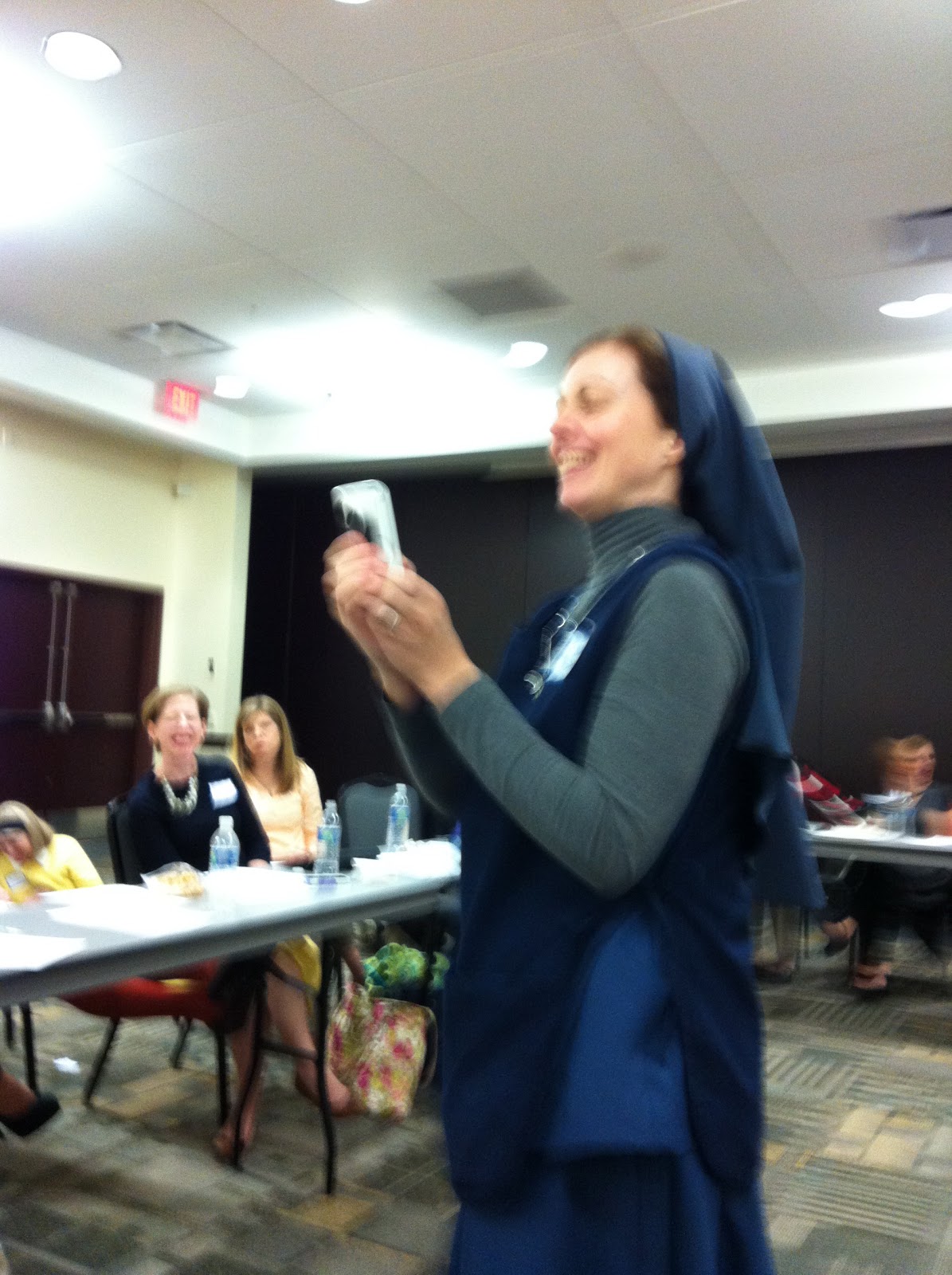
Blogger Sister Helena Burns getting a big laugh as she filmed the room during the blogger summit.  The very funny video of that can be found here.

Bloggers Sarah Reinhard, Cat Hodge, and Elizabeth Duffy


Blogger Mary Hasson with yours truly.

Two lovely blogger ladies--Hallie Lord and Bonnie Engstrom meeting in person for the first time!
Singer Marie Miller with a group of her younger superfans (as opposed to me, more mature superfan!)
Blogger Emily Stimpson meeting fellow blogger (and "Team Blogger" member) Marcia.
Blogger Jen Fulwiler and local blogger Jamie getting to meet again.
Team Blogger member Linda with blogger Sister Helena Burns
Blogger Arwen Mosher brought her sweet 10-month-old twin boys (and had help all weekend from a great friend, here in green).

More photos to come!